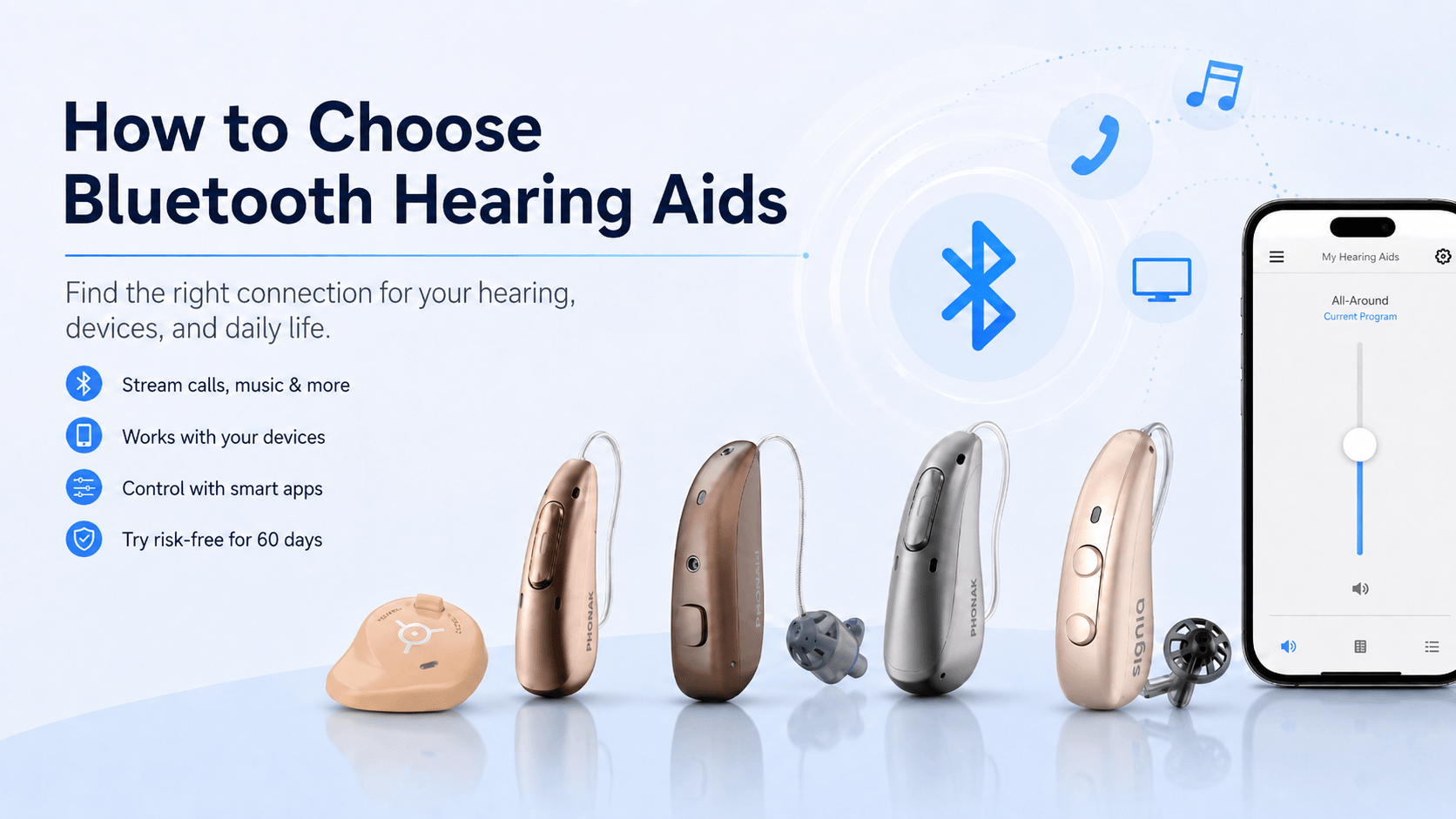
If you have small ears, finding hearing aids that fit comfortably can be frustrating. A hearing aid might feel too bulky behind your ear, slip out when you move, or put pressure on a narrow ear canal. Even a device described as “small” or “discreet” might not fit the way you expect.
The good news is that several types of prescription hearing aids can work well for small ears. Receiver-in-canal (RIC), behind-the-ear (BTE), and custom in-ear hearing aids are all possibilities. The best choice depends on the size and shape of your outer ear and ear canal (along with your hearing loss and personal preferences).
You may not even need a different hearing aid. Sometimes changing the dome, receiver, or wire length can make a big difference in comfort.
Here’s what to look for, which styles are worth considering, and how an audiologist can help you find a better fit.
What does having small ears mean for hearing aid fit?
Small ears can make hearing aid fitting more challenging, but the specific shape of your ears matters more than their overall size.
People often use “small ears” to describe different things:
- Small outer ears: There may be limited space for a hearing aid to rest behind the ear, especially if you also wear glasses.
- Narrow ear canals: Standard-sized domes or receivers can feel too tight or create uncomfortable pressure.
- Short ear canals: A receiver or in-ear hearing aid might sit too deeply or press against sensitive areas.
- Sharply curved ear canals: Some hearing aid components can be difficult to position comfortably or keep in place.
Your ears can also have a combination of these features.
For example, someone with small outer ears but average-sized ear canals may do well with a compact behind-the-ear device. Someone with average-sized outer ears and very narrow canals may need to pay more attention to the receiver and dome.
These specific kinds of differences in ear anatomy are why the smallest hearing aid on the market isn’t automatically the best hearing aid for small ears.
Which hearing aid styles work best for small ears?
Receiver-in-canal (RIC) hearing aids are often a good starting point for people with small ears, but behind-the-ear and custom in-ear styles can also work. Each has advantages and possible limitations.
| Hearing aid style | Why it can work for small ears | Considerations |
| Receiver-in-canal (RIC) | A compact housing rests behind the ear, with a small receiver inside the ear canal | Dome, receiver, and wire sizing are important |
| Behind-the-ear (BTE) | Sound travels through tubing to an earmold or earpiece, allowing different fitting options | The housing and tubing must fit comfortably around the outer ear |
| In-the-ear (ITE) or in-the-canal (ITC) | Custom-made to fit the shape of the ear | Very small ears or narrow canals might limit which designs are possible |
| Completely-in-canal (CIC) or invisible-in-canal (IIC) | Small devices that sit mostly or entirely inside the ear canal | Not every ear canal has enough space for a comfortable fit |
Receiver-in-canal hearing aids
RIC hearing aids are a versatile option for folks with small ears because the part behind your ear and the part inside your ear canal can be fitted separately.
A thin wire connects the hearing aid housing to a small speaker (called a receiver) that sits inside your ear canal. The receiver is typically covered by a soft dome or attached to a custom earmold. This design offers several ways to adjust the physical fit without replacing the entire hearing aid.
For someone with small ears, the key fit questions include:
- Does the housing sit comfortably behind the ear?
- Is the receiver small enough for the ear canal?
- Is the wire the right length?
- Does the dome stay in place without causing pressure?
A well-fitted RIC hearing aid can be discreet and comfortable, but a poorly sized receiver or dome can cause problems even when the housing itself is small.
Behind-the-ear hearing aids
Traditional BTE hearing aids can be a good option when the ear canal is too narrow or curved to fit a receiver.
With the BTE style, the receiver sits behind the ear rather than inside the ear canal. Sound travels through a tube to an earpiece or custom earmold.
This design can be useful for certain ear shapes or hearing needs, but it’s not a solution for every fitting problem. The behind-the-ear housing might still feel uncomfortable if your outer ears are small or close to your head.
Custom in-ear hearing aids
Custom in-ear hearing aids are made using an impression or scan of your ear. Depending on the design, they can sit in the bowl of the outer ear or deeper inside the canal.
It seems logical that a custom-made hearing aid would be the best choice for someone with small ears. But custom doesn’t always mean smaller, and a very narrow ear canal can limit your in-ear options.
There’s a limit to how small in-ear hearing aids can be, because they have to contain certain components in order to function. For some people, a small ear canal can make a CIC or IIC device difficult or unsuitable.
Audiologist Kristen Conners says this is one reason she often recommends receiver-in-canal hearing aids for patients with narrow ear canals:
“As long as the outer ear isn’t too small, we recommend the RIC style. If we try to build a custom product for a patient with small canals, they have to be quite large as the components won’t fit in the canal portion of the hearing aid. Patients are usually dissatisfied with the cosmetic appearance of the larger in-the-ear aids.”
What makes a hearing aid fit comfortably in a small ear canal?
A comfortable fit depends on several different parts, not just the overall size of the hearing aid. The receiver, dome, wire, and earmold can all affect how the device feels and how well it stays in place.
Receiver size and power
The receiver is the tiny speaker that delivers amplified sound into your ear canal.
RIC hearing aids can have different receiver sizes and power levels. A smaller receiver might be easier to fit in a narrow canal, but it also needs to provide enough output for your hearing loss.
The sweet spot is balancing physical comfort with the amount of amplification you need. Choosing the smallest receiver without factoring in your hearing evaluation can compromise the fitting.
Dome size and shape
The dome is the soft silicone tip that covers the receiver and sits inside your ear canal.
Domes come in different sizes and designs. Your audiologist may consider a smaller dome, a different shape, or a different level of ventilation depending on your ear anatomy and hearing needs.
But for people with small ears, the smallest dome isn’t necessarily the most comfortable or effective option.
A dome that’s too large can create pressure. One that’s too small can slip, move around, or allow amplified sound to leak out and cause whistling. The dome also affects how sound reaches your eardrum, so changing it might require adjustments to the hearing aid’s settings.
If you’ve tried several dome sizes without finding relief, the problem might be with the receiver and/or the shape of your ear canal rather than the dome alone.
Receiver wire length
The wire connecting a RIC hearing aid to the receiver comes in different lengths.
If it’s too short, the wire pull the receiver into an uncomfortable position or keep the housing from sitting properly behind your ear. If it’s too long, the receiver can shift or the housing might feel unstable.
Getting the wire length just right is especially important for people with smaller outer ears.
Custom earmolds
For some people with small ears, a custom earmold might offer a more secure, comfortable alternative to a standard dome.
An earmold is made from an impression or scan of your ear. It connects to the hearing aid’s receiver or tubing (depending on the style).
Custom earmolds can help with certain problems involving retention, pressure, or sound leakage, but they still need to be carefully designed, fitted, and sometimes modified.
A custom earmold isn’t the same as a custom in-ear hearing aid. With a RIC hearing aid, you can use a custom earmold while keeping the main hearing aid housing behind your ear.
This is one way people with small ears might be able to improve the fit of their current hearing aids without switching to a whole different style.
Conners also recommends custom earmolds in certain situations where a standard dome may not be the best option, particularly for people who have difficulty handling small hearing aid components or need more amplification:
“Custom earmolds, which are attached to RIC hearing aids, are good options for people with limited dexterity. There’s more “body” for the patient to grab/hold onto which can make insertion easier. Also, custom earmolds are recommended if the patient has a severe to profound loss. A tighter seal and fit is needed for the patient to get the proper amplification.”
What if your hearing aids hurt or won’t stay in place?
Hearing aids shouldn’t cause persistent pain. Sometimes it takes time to get used to the sensation of wearing hearing aids. But getting accustomed to a device is different from tolerating ongoing pain. If yours pinch, rub, slip, or feel uncomfortable after you’ve been wearing them for a while, ask your audiologist to check the physical fit.
Here are some common fitting problems related to small ears, and what each might indicate:
| Issue | What to check |
| Pain or pressure inside the ear canal | Dome size, receiver dimensions, insertion depth, or pressure points |
| Soreness behind the ear | Housing position, wire length, and available space around the outer ear |
| Hearing aid keeps slipping out | Dome style, receiver wire length, retention options, or a custom earmold |
| Whistling or feedback | Earpiece seal, receiver position, wax buildup, and acoustic settings |
| Your own voice sounds boomy or plugged up | Dome ventilation, earmold design, and sound settings |
What if you wear glasses?
If you have small ears and wear glasses, the space behind your ears can feel especially crowded. A hearing aid, eyeglass arm, and sometimes a face mask or other accessory might all need to share limited space.
A more compact housing can help, but how it’s positioned matters as much as its overall size. Ask your audiologist to check how it fits while you’re wearing your everyday glasses.
What if you’ve already tried the smallest domes?
If hearing aids with the smallest available domes still hurt, don’t assume you have to live with the discomfort.
The receiver itself might be too large for your canal, the wire might be positioning it incorrectly, or your canal could have a bend that makes standard components uncomfortable. Depending on your circumstances, an audiologist could recommend a different receiver, earpiece, earmold, or hearing aid style.
When the smallest domes still cause discomfort, Conners says she looks at two other parts of the fitting:
“The next thing to look at would be the length of the wire, as it could be too short which could cause rubbing in the upper portion of the canal. Second would be checking the lock wire. Sometimes they can put a little extra pressure on the dome and receiver wire, causing discomfort.”
Never force a painful earpiece farther into your ear. If you have significant pain, bleeding, discharge, or signs of irritation or infection, stop wearing the device and seek medical care.
Which hearing aids are worth considering for small ears?
The best hearing aids to consider are ones that can be fitted to your specific ear anatomy and provide the right amplification for your hearing loss. Prescription Hearing carries several receiver-in-canal models from leading brands like ReSound, Phonak, and Signia. The models below are all worth considering if you have small ears. Ultimately, the best one depends on your ear anatomy and hearing needs. They’re listed in no particular order.
ReSound Sensia Micro RIE
ReSound Sensia is available in a rechargeable micro receiver-in-ear design, with technology levels 4, 5, 7, and 9.
Its compact behind-the-ear design is worth considering if you’re concerned about a hearing aid feeling bulky around your outer ear.
Keep in mind that even a micro RIE hearing aid needs the right receiver, dome, and wire configuration to fit a narrow canal comfortably.
Of the hearing aids available from Prescription Hearing, Conners particularly recommends the ReSound Sensia for people with petite ears:
“The Resound Sensia model is the smallest RIC hearing aid on the market. This is a great option for petite ears. A lot of manufacturers’ domes are interchangeable which allows a lot of different options for tiny canals.”
Phonak Audéo EON and EON Sphere
Prescription Hearing also offers Phonak Audéo EON and Phonak Audéo EON Sphere hearing aids.
These receiver-in-canal options are worth comparing if you’re interested in Phonak’s sound-processing technology and connectivity features.
The key fitting question isn’t just which model has the smaller housing – the appropriate receiver and earpiece also need to sit comfortably in your ear canal.
Signia MaX
Signia MaX is another rechargeable RIC hearing aid, and this one is available with technology levels 3, 5, and 7.
Like the other models, its suitability for small ears depends on the combination of housing fit, receiver options, and individual ear anatomy.
What about custom-molded hearing aids?
If you’d prefer a hearing aid that sits entirely or mostly inside your ear, ask us about our custom-molded options from manufacturers such as Phonak, ReSound, and Signia. Prescription Hearing can help you explore appropriate custom options through our in-person audiology services. Custom-molded hearing aids can’t be purchased online since the mold has to be taken in person at our Palos Park hearing center.
This style requires a closer assessment of your ear anatomy to determine if a suitable device can be made. Very small or narrow canals might not work with certain custom styles.
For patients who strongly prefer an in-ear hearing aid, Conners says there’s still a way to explore whether a custom device will work.
“If someone is requesting a custom hearing aid, we can always take an impression and have the manufacturer build it to see how big it is. Custom hearing aids are refundable within our 60-day trial so we have that option if the patient insists on in-the-ear hearing aids.”
The takeaway: Don’t choose a hearing aid based on a product photo or a claim that it’s exceptionally small. It still has to fit your ears, provide the right amount of amplification, and work well in the situations where you need to hear better.
How to choose hearing aids that fit your small ears and your hearing needs
Start with a hearing evaluation and an assessment of your ear anatomy. Then compare the hearing aid styles and fitting options that make sense for both.
A hearing aid fitting process usually involves four steps:
1. Understand your hearing loss
Your hearing evaluation helps determine how much amplification you need and which hearing aid styles and receiver options can provide it.
The goal isn’t finding the smallest possible hearing aid. It’s finding a device capable of helping you hear the sounds and conversations you’re currently missing, that’s also comfortable to wear.
2. Have your ears examined
Your audiologist can look at the size and shape of your outer ears and ear canals, check for wax or other concerns, and identify factors that could complicate the fit.
Be specific about previous problems you’ve had. If you’ve worn hearing aids that hurt, slipped out, or didn’t work with your glasses, describe exactly what happens.
3. Compare fitting options
Once your audiologist understands your hearing needs and ear anatomy, you can compare hearing aid styles. This might include trying different domes, receiver sizes, wire lengths, or considering custom earmolds.
Your preferences matter, too. While comparing styles, think about how easily you can handle the hearing aids, what you want them to look like, and the environments where you need to hear well.
4. Evaluate comfort in everyday use
A hearing aid that feels fine for a few minutes in the office might get uncomfortable after a few hours.
Pay attention to how it feels while you’re talking, chewing, putting on glasses, and going about your usual activities. Make note of any pressure, slipping, or soreness so you can share detailed feedback with your audiologist (physical fit and sound settings could both need adjustments).
Prescription Hearing can help you shop for and fit hearing aids in person at our Palos Park (Illinois) office, you can also buy hearing aids from us online with free shipping, and enjoy remote support available anywhere in the U.S.
Keep in mind while remote programming is great for adjusting sound settings, certain physical fitting problems may require an in-person examination or hands-on changes to the hearing aids.
For patients who live too far away to visit Prescription Hearing’s Palos Park office, Conners says there are still some fitting adjustments the team can help with remotely:
“We can send a couple different length wires and domes to try if they live far away but if relatively close by, we would ask them to come into the office for the best care.”
Hearing aids from Prescription Hearing come with a 60-day risk-free trial, no questions asked. That gives you time to wear your hearing aids in everyday situations and make sure they feel comfortable, fit securely, and work well for your hearing needs.
Frequently asked questions about hearing aids for small ears
What are the smallest hearing aids for small ear canals?
Invisible-in-canal (IIC) and completely-in-canal (CIC) hearing aids are among the smallest hearing aid styles. But they might not work for very narrow or short ear canals because the components still need a certain amount of space. A compact receiver-in-canal hearing aid may be a better option, depending on your ear anatomy.
Which is better for small ears: in-ear or behind-the-ear hearing aids?
Neither style is automatically better. In-ear hearing aids avoid having a housing behind the ear, but require enough room inside the ear or canal. Behind-the-ear styles can be easier to fit in narrow ear canals, but the housing still has to fit comfortably around your outer ear. An audiologist can help identify the best match for your particular inner and outer ear anatomy.
Are there hearing aids designed for women with small ears?
Hearing aids generally aren’t fitted according to gender. Some women can have smaller ears or ear canals, but the truth is ear anatomy varies widely from person to person. A proper fitting accounts for your individual measurements, hearing loss, and preferences rather than whether a device is marketed toward women or men.
Can you get custom hearing aids for very narrow ear canals?
Sometimes. Custom hearing aids are made to fit your ears, but there’s a limit to how small they can be. If your ear canals are too narrow, there may not be enough room for the hearing aid itself. In that case, a receiver-in-canal or behind-the-ear model with a custom earmold may be a better option.
Does having small ears affect your hearing?
Having small outer ears doesn’t automatically mean you’ll have hearing loss. But differences in ear anatomy can sometimes affect how sound travels through the ear, and certain structural conditions can be associated with hearing difficulties. If you’re concerned about your hearing, an evaluation can help identify whether hearing loss is present and what’s contributing to it.
Your ears are unique. Your hearing aid fit should be, too!
Having small ears doesn’t mean putting up with uncomfortable hearing aids. With the right style, receiver, dome, or earmold, many people can find a fit that works for their unique ear size and shape as well as their hearing needs.
If you’re struggling with the fit of your current devices (or you’re shopping for new hearing aids and aren’t sure which styles will work) Prescription Hearing can help you understand your options.
Our licensed audiology team offers in-person care in Palos Park, serving the Chicago area, as well as remote hearing aid support across the U.S.
Contact Prescription Hearing to discuss your hearing needs and find out which fitting options may be right for you.